Image here — 1200 × 900 px
Anthony: A municipal finished-water tank or covered reservoir from outside, with the deployment rig set up on the roof. Should read unmistakably as drinking water infrastructure — clean, civic, no industrial clutter.
Potable water storage and reservoirs
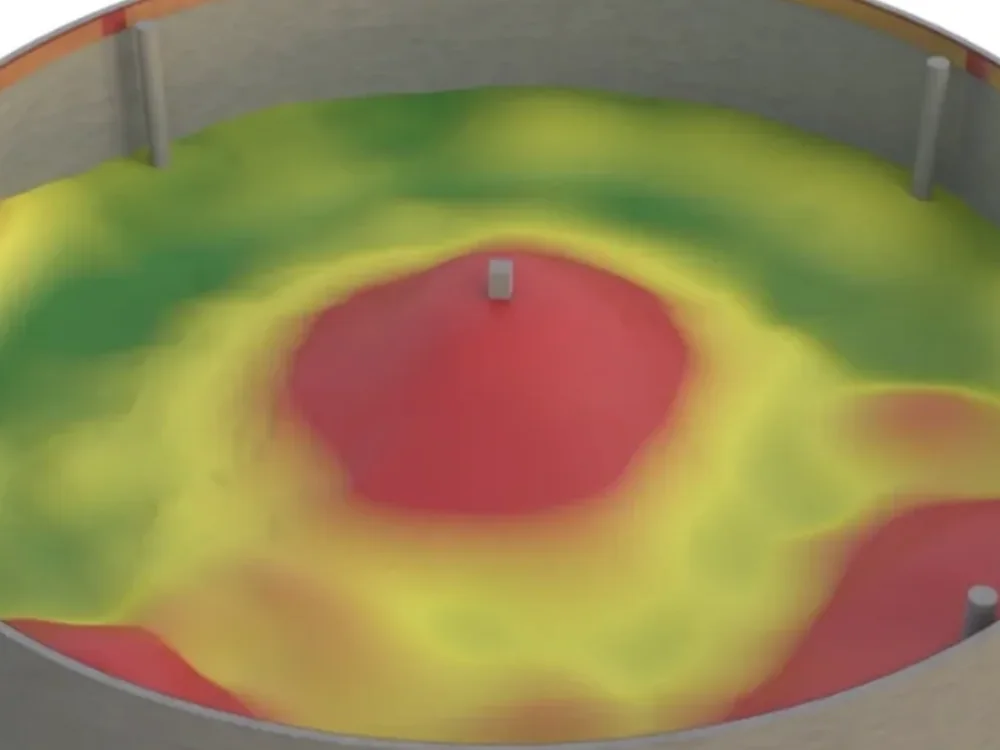
Finished water tanks, clearwells and covered reservoirs. A settled sediment blanket shields the layer beneath it from the chlorine residual carried in the open water, and those unchlorinated dead zones are where organic growth begins. Cleaning while the tank stays in service means the network keeps its storage, its pressure and its fire reserve throughout.
AWWA C652-19 sanitation · NSF-61 equipment guidance
Image here — 1200 × 900 px
Anthony: A fire-water tank at an industrial site with the plant behind it. Red pipework, a fire main or hydrant in frame so it reads as fire protection rather than just a tank.
Fire-water tanks
NFPA 25 requires internal inspection every three years for steel tanks without cathodic protection and every five years otherwise, and requires sediment to be removed from the floor where inspection is carried out by underwater means. Doing that without draining keeps the suppression system available the whole time.
NFPA 25 · sections 9.2.5.1 to 9.2.5.3
Image here — 1200 × 900 px
Anthony: A process water tank inside a working plant — pipework, steel structure, production visibly running around it.
Process, raw and demineralised water
Solids arrive from collection, from chemical reactions, from the degradation of the plant itself. Left alone they clog sprinkler networks, shift pH, accelerate corrosion and cut thermal efficiency — and the shutdown needed to deal with them usually costs more than the cleaning.
Online during normal production
Image here — 1200 × 900 px
Anthony: A cooling tower with the fans turning and plume visible, framed to include the basin at ground level where the sludge actually sits.
Cooling towers, basins and lagoons
Basin sludge is removed with the tower running. Access is usually awkward and difficult, which is what a configurable tool carrier is for. Cooling towers provide clean cooling so the heat exchangers work efficiently. Any sludge entering will cause damage and interruption of service. Cleaning the cooling tower in service not only prevents this problem but gives the operator a chance to identify the sludge source and prevent future problems.
First cooling tower sludge removal, 2004
Image here — 1200 × 900 px
Anthony: A fuel or crude storage tank at a terminal or refinery, with hazardous-area signage in frame. Tank farm in the background if possible.
Hydrocarbon and classified areas
Fuels, oils and hydrocarbons in plain storage tanks, with hazardous-area protection methods applied to the submerged equipment. Includes a certified EX deployment and dedicated navigation and imaging developed for use in hydrocarbons.
Stainless build · Zone 0 experience
Image here — 1200 × 900 px
Anthony: The offshore platform from the March 2022 job — deck level or shot from the water, so the isolation of the asset is obvious.
Offshore and remote assets
Where mobilising a conventional cleaning crew is expensive and taking the asset down is worse. Includes the first inspection and cleaning of a water storage tank on an active offshore platform while it remained in service, in March 2022.
Offshore, March 2022